
What began as a stylized gamble from a studio already riding the Genshin Impact wave has matured into a full-fledged cross-platform phenomenon. By 2026, miHoYo’s Zenless Zone Zero no longer needs to prove its staying power—it has become a fixture of the urban fantasy action RPG landscape, flourishing on consoles, PC, and mobile with the momentum of a runaway hover train dodging through the Hollows’ shattered geometry.

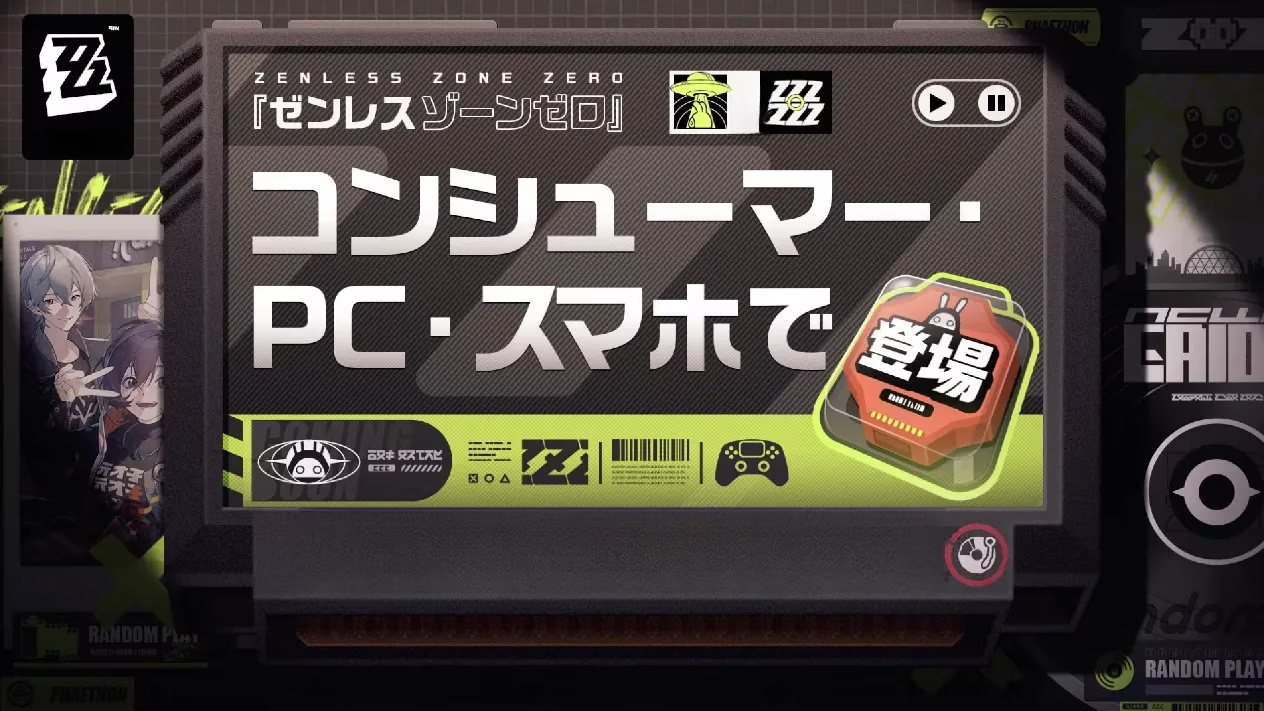
The game’s journey to omnipresence was sealed during a pivotal Tokyo Game Show 2023 broadcast, where a closing card casually confirmed what fans had been hoping for: Zenless Zone Zero was headed to “consoles, PC, mobile.” At the time, development was publicly attached only to Windows PC and smartphones, making the console promise feel like a distant neon silhouette. A few years later, that silhouette is now fully illuminated. Backward-looking industry observers might liken the expansion to a three-act jazz suite—PC and mobile laid the rhythm section, then console versions joined as the brass, transforming a catchy melody into a wall of sound that resonates worldwide.
Set in a post-apocalyptic metropolitan haven called New Eridu, Zenless Zone Zero weaves a narrative around the “Hollows”—supernatural disasters that spawn chaotic dimensions populated by ethereal monsters. Contemporary civilization crumbled, but New Eridu survived by mastering the extraction of valuable resources from these anomalies, effectively turning catastrophe into a booming industry. The result is a city that glitters like a broken chandelier wired into a generator: miraculous, yet crackling with tension among monopolistic corporations, gangs, conspirators, and fanatics.
Players step into the shoes of a “Proxy,” a specialist who guides people venturing into the Hollows. This narrative framing works as a clever invisible handshake between lore and gameplay. Every trip into the fractured zones feels like being a digital cartographer in a fever dream, charting pathways that shift and morph according to the game’s roguelike mechanics. The roguelike layer isn’t just a buzzword bolted onto the experience—it acts as a narrative sieve, straining each sortie through procedural uncertainty, so that even veteran players find themselves improvising like jazz cats in a nightclub that keeps rearranging its own walls.
Combat remains the glittering core. The 3D anime-style visuals deliver fluid, cinematic action where players swap between characters mid-combo, unleashing crackling skills and almost absurdly satisfying QTE chains. If fighting in many action RPGs is a carefully rehearsed stage play, Zenless Zone Zero feels more like a parkour duel on a moving freight train—the environment is alive, the stakes visceral, and the rhythm demanding. On consoles, this system gained an extra layer of finesse. The tactile feedback of a controller helped the rapid character-switching feel less like a sequence of button taps and more like conducting an electrical surge through the player’s own fingertips.
By 2026, the cross-platform ecosystem has matured into a model of seamless synergy. A player can start a Hollow exploration on a PlayStation 5 during the afternoon, continue on a smartphone while commuting, and finish the run at a PC battle station in the evening—all progress persisting like a shared consciousness across devices. This fluidity has turned the player base into a roaming collective that no longer asks “what platform are you on?” but rather “which proxy crew are you rolling with tonight?”
The world of New Eridu has expanded steadily through post-launch updates, introducing new factions, Hollow depths, and limited-time events that often tie back into the city’s simmering power struggles. One recent season-themed update, for example, peeled back the curtain on an underground casino syndicate operating within a Hollow that mutates based on the debts its gamblers owe—a narrative layer so thematically rich that it could stand alone as a cyberpunk novella.
Visual and auditory polish remain cornerstones of miHoYo’s approach. The character designs pop with futuristic tailoring and asymmetrical flair, while the soundtrack bounces between pulsing electronica and melancholic vocal tracks, as if a retro-future radio station is broadcasting on a frequency only New Eridu can tune. Voice acting, offered in multiple languages, cements the global reach the console announcement once merely hinted at.
Community reception has underscored that the console debut was not a simple port but a reaffirmation of the game’s ambition. Critics often point to Zenless Zone Zero as an example of how modern live-service titles can marry style and substance without tripping over their own monetization heels. The roguelike exploration, combined with a combat system that rewards twitch skill and tactical tag-team composition, hits a sweet spot rarely found outside dedicated single-player action games. The console transition amplified this by removing the input limitations of touchscreens, letting the game breathe in a way that attracted even action purists who traditionally keep live-service titles at arm’s length.
As the sun sets on 2026, Zenless Zone Zero stands as a testament to miHoYo’s growing mastery of the cross-platform pipeline—a pipeline that once seemed like a wish sketched on the conference hall floor of TGS 2023. The game now serves as a living document of how a post-apocalyptic setting doesn’t have to be bleak; it can be a neon-soaked sandbox where every proxy run tells a new short story, and where console, PC, and mobile players alike chase the same electric high. In a landscape crammed with forgettable gacha experiences, this one continues to spin like a turntable needle on a record that refuses to skip—even after countless plays across three different systems.